
Databases
Load a data table from a spatial database or data store into a map
Available on editionsStandardProfessional
To access spatial databases or data stores in Spatial Manager Desktop™ you first need to have defined a User Data Source (UDS). A UDS is a saved connection configuration that stores all the parameters needed to connect to a specific database or data store, so you don’t have to enter them each time. To learn more about UDSs, see: Data sources page.
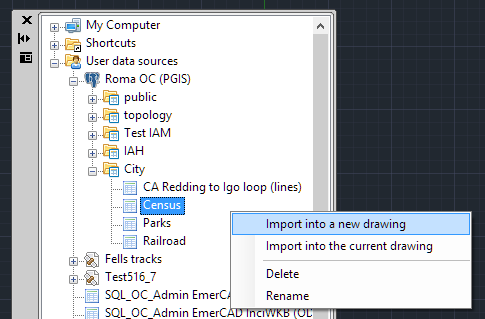
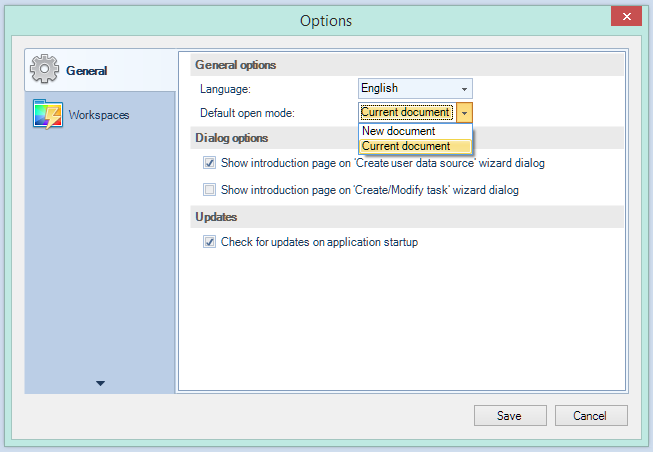
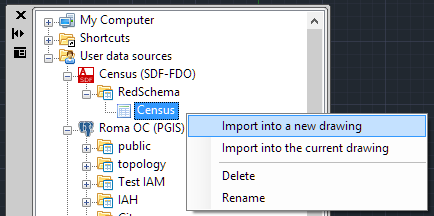
You can load a data table from a spatial database or data store using the right-click menu over the table item itself inside a container of the UDS (usually a schema) in the “Data sources” panel, to load its content into a new or existing map. You can also double-click the table item itself in the “Data sources” panel to load its content into a new or existing map (this behaviour may be configured in the application settings).
Other functions for the tables
Available on editionsStandardProfessional
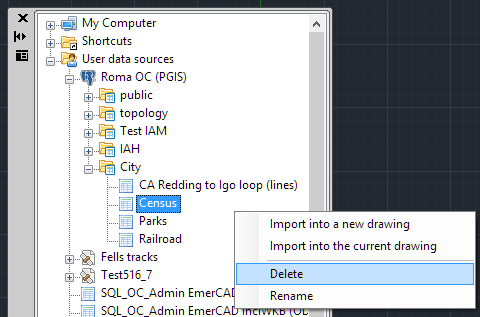
You can delete or rename the tables in Spatial Manager Desktop™ using the right-click menu over the table item itself. This is valid for tables in spatial databases but not for tables in data stores.
Create a schema in a spatial database
Available on editionsStandardProfessional
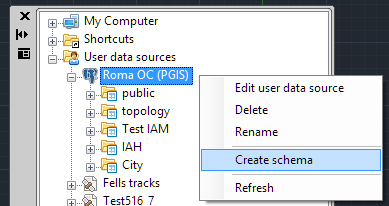
You can create a schema in a spatial database in Spatial Manager Desktop™ using the right-click menu over the UDS. When creating, you can assign a name to the new schema.
Other functions for the schemas
Available on editionsStandardProfessional
You can delete or rename the schemas and refresh the schema contents in Spatial Manager Desktop™ using the right-click menu over the schema item itself. Be careful when you delete a schema because all the tables that it contains will also be deleted. This is valid for schemas in spatial databases but not for schemas in data stores.
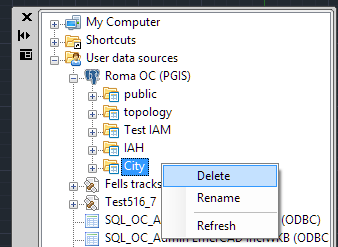
Other kinds of data sources using schemas or tables
You can find some providers using schemas or tables in Spatial Manager Desktop™, besides spatial databases or data stores, such as some types of files like SDF and more, or special connections such as ODBC (“Standard” and “Professional” editions only) and more. Everything said here for schemas and tables is valid for these types of data sources.
See the properties of schemas or tables
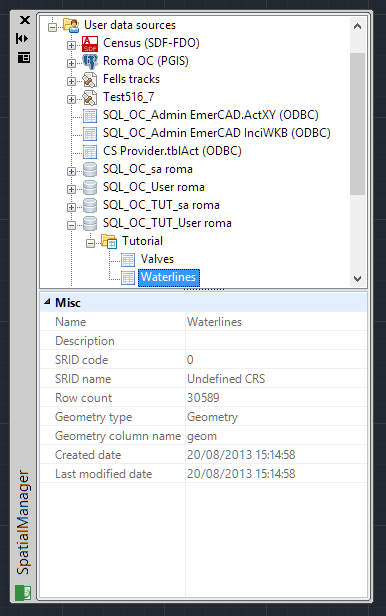
You can see the properties of schemas or tables in the “Properties” panel of Spatial Manager Desktop™ when you select any of these items in the “Data sources” panel.
Disclaimer:
- Some components shown here (providers, names, window styles, etc.) may differ slightly from those on your computer.
- Certain features require Internet access. If you experience issues, check with your network administrator about a possible Proxy server. You can configure the Proxy settings in the application options.
- Some geographic data providers (Geocode, image maps, etc.) may require a user account, which you can set up in the Service Provider API Keys section of the application options.