
Coordinate transformations
Imports spatial data, into new or existing BricsCAD drawings, as BricsCAD objects and Extended Entity Data (EED).
Define a Transformation of coordinates
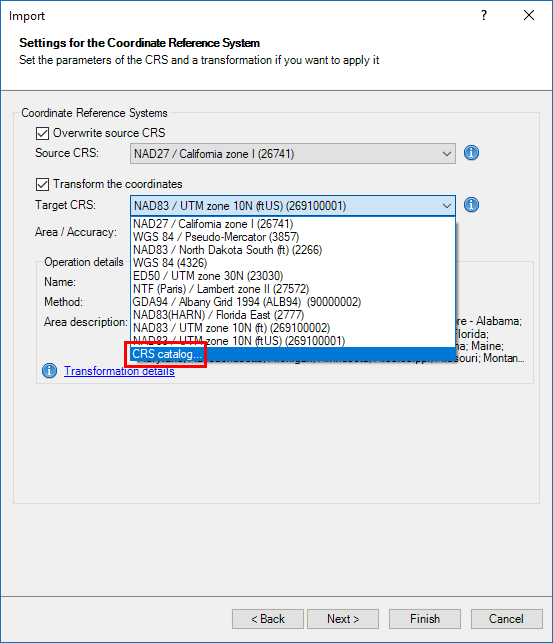
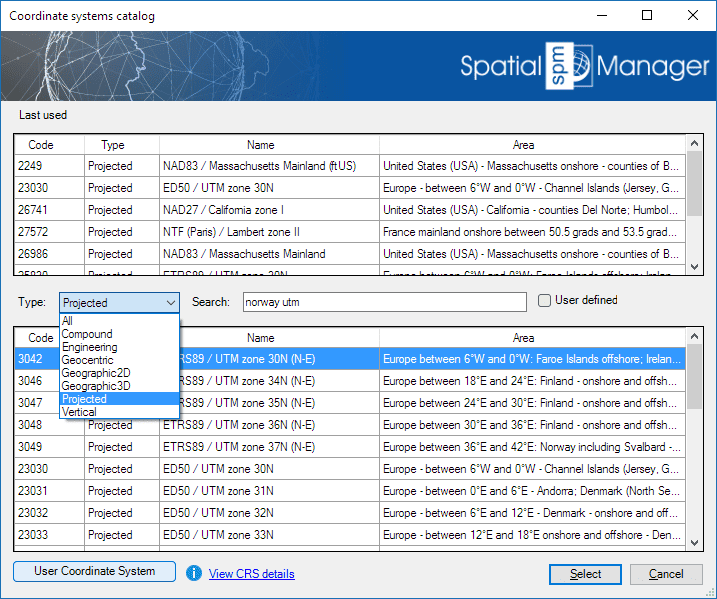
When you are importing Features as BricsCAD entities using Spatial Manager™ for BricsCAD, you will see that you can choose a Transformation of coordinates from the source Features to the entities in the drawing, in the “Import” wizard. This means that the application will calculate a geometric transformation between the source and the target data, which will depend on the chosen CRS for the source (incoming Features) and for the target (imported BricsCAD entities) data. You can choose the appropriate CRSs by clicking on “CRS catalog…” in the CRS dropdown list for the source or for the target data. In the CRS table you can:
- Filter the CRSs by type (Geocentric, Projected, etc.).
- Choose a CRS by clicking on its row in the table.
- Search CRSs by typing the search criteria in the “Search” box. You can type here as many words as you like separated by blanks. The application will find all the rows including all these words in any column of the table.
After choosing a pair of valid CRSs for a Transformation, you can choose the geographic Area to apply it to (the application will choose by default the most common Area for this Transformation).
If the application “knows”, “guesses” or “can assume” the CRS of the source and/or the target (drawing) data, it will be chosen by default. You will be able to modify this choice except in cases where only one CRS is valid; for example, for a KML or a KMZ file the only valid choice is the CRS “WGS84 (SRID 4326)”, because these types of file are always defined using this CRS.
You can assign a CRS to the drawing or modify it using the command SPMSETCRS. By executing this command, you will access the CRS Catalog of the application described in the previous lines. In this case the Type “Projected” will be selected by default because it is the most common choice.
- When importing a table defined using a known CRS into a drawing without an assigned CRS, the CRS of the table is automatically assigned to the drawing.
- If you change the target CRS by choosing any CRS other than the drawing CRS, you will get a warning from the application, but you can continue and perform the Transformation of coordinates if you want to.
- Notes:
- To unassign (undefine) the coordinate system of the drawing, choose “Undefined CRS” (EPSG 0).
- As you will see, the CRS dropdown lists will include more and more CRSs as they have been previously chosen in other Transformation operations, so that you can choose your “last-used” CRSs directly from the dropdown list without having to access the CRS Catalog all the time. In addition, the CRS Catalog window shown when you execute SPMSETCRS to assign a CRS to the drawing or modify it also includes a list of the “last-used” CRSs (if any) in the upper zone.
- If the incoming data is defined using the CRS “WGS84 (SRID 4326)” and the drawing has not assigned any CRS, the transformation to the CRS “WGS 84 / Pseudo-Mercator (SRID 3857)” is selected by default to get a projected map instead of a flat representation of geodesic coordinates.
- Coordinate Systems and Transformation details
- Coordinate Systems entities available in the current version
Disclaimer:
- Some components shown here (providers, names, window styles, etc.) may differ slightly from those on your computer.
- Certain features require Internet access. If you experience issues, check with your network administrator about a possible Proxy server. You can configure the Proxy settings in the application options.
- Some geographic data providers (Geocode, image maps, etc.) may require a user account, which you can set up in the Service Provider API Keys section of the application options.