
Selection
Manage the alphanumeric data attached to the objects, design and edit the structure which will be used to store the data in GstarCAD.
Select by data values or geometric relationship
‘Spatial Manager™ for GstarCAD’ includes several commands for advanced selection tasks.

- SPMSPATIALQUERY allows you to select entities in the drawing according to the result of advanced simple or compound spatial queries.
- SPMSELECTBYQUERY allows you to select entities in the drawing according to the result of a simple or compound data query.
- SPMSELECTBYTABLE allows you to select all the entities that have been previously attached to a specific data table.
- SPMSELECTINVERSE allows you to invert the selection of entities in the drawing.
- SPMZOOMTOSELECTION zooms to the current selection extent so you can locate all the selected entities in an optimal size view, and SPMZOOMTOSELECTIONLAYER zooms to all the entities included in the layers corresponding to the selected entities.
Select entities based on data values
The command SPMSELECTBYQUERY in Spatial Manager™ for GstarCAD allows you to select entities in the drawing according to the result of simple or compound data queries.

- The query can be applied to one data table or to all the data tables defined in the drawing.
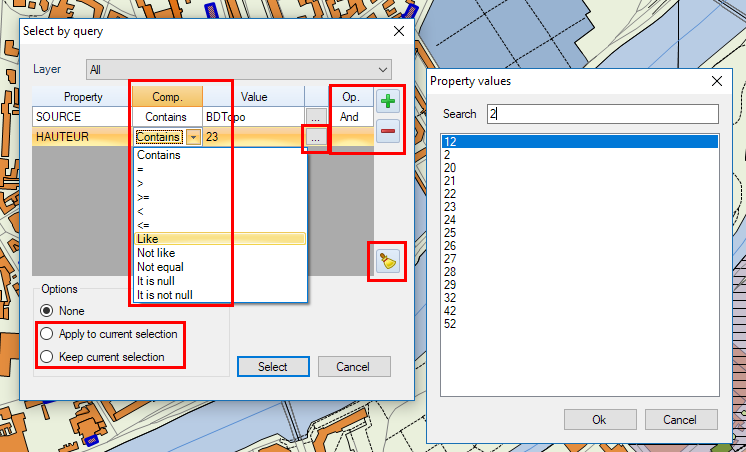
- Click on the “+” button to add at least one condition and thus create a data query (a condition that stands for “Property & Comparator & Value”).
- When you are defining a compound query, you can add as many conditions as you want to the conditions list. Click on the “+” button each time you need to add a condition.
- You can select the logical operators “And” or “Or” when adding new conditions. “And” will be the default operator.
- In addition, if there is any entity selected when you run the command, you can:
- Apply the query to the current selection and not to the entire drawing, or,
- Keep the current selection so the new “query selection” will be added to the current selection.
- Notes:
- You can choose and search (…) among the available values for a field.
- The command keeps the list of query conditions used the last time it was executed.
- If there are no results during a query, the command window is shown again and keeps the list of query conditions.
- You can use the “-“ button every time you need to remove a condition from the conditions list in the query, or you can use the Clean button (the “broom”) to remove all query conditions from the list.
You can use the command SPMZOOMTOSELECTION (see below) to quickly zoom to the selection extent.
Select the entities attached to a data table
You can select all the entities that have been previously attached to a specific data table. To do that, execute the command SPMSELECTBYTABLE of Spatial Manager™ for GstarCAD. You will find this command in the “Spatial Manager” GstarCAD ribbon.

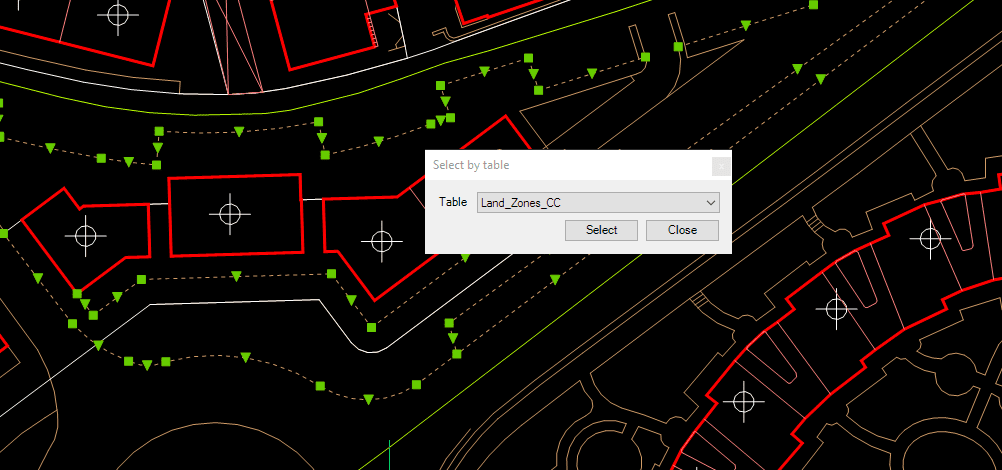
To choose the one you want, click on the data tables drop-down list.
Note: You can use the command SPMZOOMTOSELECTION (see below) to quickly zoom to the selection extent.
Disclaimer:
- Some components shown here (providers, names, window styles, etc.) may differ slightly from those on your computer.
- Certain features require Internet access. If you experience issues, check with your network administrator about a possible Proxy server. You can configure the Proxy settings in the application options.
- Some geographic data providers (Geocode, image maps, etc.) may require a user account, which you can set up in the Service Provider API Keys section of the application options.